

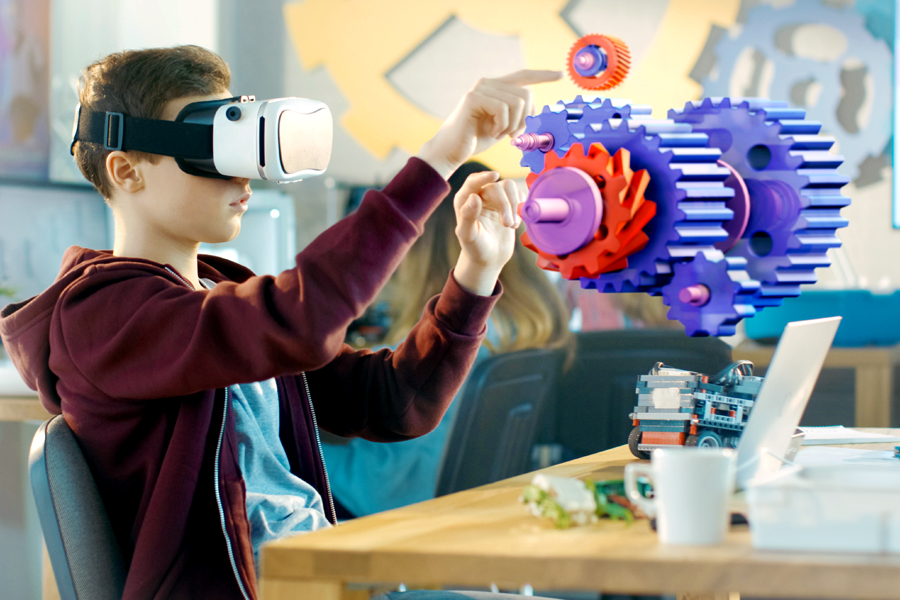
In today's education system, students often struggle to retain theoretical knowledge, and this is where virtual labs come in as a solution. While traditional lectures and visuals can provide students with information, they do not always provide the hands-on experience needed for students to truly understand and retain the material. With virtual labs, students can actively engage with the material and conduct experiments in a simulated environment, leading to a more effective and efficient learning experience.
Virtual labs are becoming increasingly popular in K-12 education, and for good reason. They offer a wide range of benefits over traditional physical labs, and one such virtual lab is Reherse that is designed to provide a safe, engaging, and cost-effective way for students to conduct experiments and explore scientific concepts. Here are 9 benefits of using virtual labs in K-12 education:
Enhanced Hands-on Learning: Virtual labs provide students with the opportunity to conduct experiments and explore scientific concepts through hands-on learning, which is proven to be more effective than theoretical learning. This enhances the students' understanding of the concepts, and they retain the knowledge for a longer period of time.
Cost-effective Solution: Virtual labs are cost-effective as they do not require expensive equipment or lab space. Reherse, in particular, does not require any lab assistants, setup or cleanup time, and it does not have any equipment costs or availability issues. This makes it an affordable solution for schools with limited resources.
Risk-Free Environment: Virtual labs are risk-free as students can conduct experiments without any risk of physical harm. This allows students to experiment with concepts that may be too dangerous to conduct in a traditional physical lab.
Flexibility in Learning: Virtual labs provide students with the flexibility to conduct experiments at any time, without the need of a dedicated lab. Reherse virtual lab can be used starting from grade 6 and it's always up to date with the latest syllabus. This allows students to learn at their own pace and schedule.
Engaging and Interactive: Virtual labs are more engaging than traditional physical labs as they provide students with interactive guidance and real-time feedback from their teachers. This keeps the students more interested and actively involved in their learning.
Exploration of Complex Topics: Virtual labs allow students to explore complex topics that may not be possible in traditional physical labs. This allows students to study topics that would otherwise be out of reach due to cost or safety concerns.
Instant Feedback and Improvement: Virtual labs provide students with instant feedback, which allows them to learn from their mistakes and improve their experiments. This helps students to understand their errors and improve their understanding of the concepts.
No Equipment Purchase or Clean-up: Virtual labs do not require any equipment purchase or clean-up, making it easy for schools to implement and maintain. This eliminates the need for schools to invest in expensive equipment or spend time and resources on cleaning and maintenance.
No Lab Assistants Required: Virtual labs do not require any lab assistants, which can be a cost-saving measure for schools. This allows schools to allocate resources towards other areas of education.
In conclusion, virtual labs like Reherse are revolutionizing the way students learn and experiment in K-12 education. They provide students with a safe, cost-effective, and engaging way to conduct experiments and explore scientific concepts. With virtual labs, students can learn through hands-on experience, interactive guidance, and real-time feedback from their teachers, and teachers can track the progress of their students and guide them for improving their experiments. Reherse is one such virtual lab platform that offers all these benefits to the students and teachers. You can check more details on our website www.reherse.com

